
Gators All-SEC honors put a bright preseason marker on three Florida players, but the names need careful handling before the football talk starts. The available research identifies Jadan Baugh, Vernell Brown III and Jayden Woods as Florida’s 2026 preseason All-SEC honorees. The user-submitted topic listed Shemar Brown III and Marcus Woods, but the verified research provided for this assignment points to Vernell Brown III and Jayden Woods, so this analysis uses those source-backed names.
That distinction matters because preseason recognition can become a shortcut for big claims. I’d rather keep the focus where it belongs: what each player has already shown on the field, where that production fits within Florida’s roster, and how those traits could affect game-day identity in Gainesville. WRUF reported that Baugh, Brown and Woods earned 2026 preseason All-SEC recognition, with Baugh on the Second Team at running back and Third Team as an all-purpose player, Brown on the Third Team as a return specialist, and Woods on the Third Team as a defensive lineman WRUF preseason report.
What Gators All-SEC honors Signal For Florida
Gators All-SEC honors And The Evidence Behind Them
Preseason lists are not guarantees. They are snapshots built from prior production, reputation and league expectations. For Florida, this group is notable because it reaches three different areas of the roster: backfield volume, return-game field position and defensive-front disruption. That gives the Gators a useful spread of recognized talent rather than one isolated star.
Baugh brings the most established offensive workload of the trio. The Florida athletic department’s 2025 All-SEC release listed him as a 12-game starter who ran 220 times for 1,170 yards and eight touchdowns, while adding 31 catches for 185 yards and two receiving scores. The same release stated that his rushing total ranked sixth on Florida’s single-season list Florida team release. That is not just a box-score flourish. In SEC play, a runner with that usage gives an offense a stable weekly starting point, especially when drives get tight and weather or crowd noise shrink the playbook.
Brown and Woods carry a different kind of signal. The research credits Brown with leading Florida in receptions and receiving yards as a true freshman, while also handling return work. Woods, also noted in the research as a true freshman contributor, appeared in all 12 games and co-led the team in sacks. Because the approved source list for this article includes the WRUF preseason report and Florida’s Baugh-related release, I am treating the Brown and Woods details strictly as provided research and not stretching beyond them.
Why The Distribution Matters Locally
For a Gainesville audience, the spread of recognition matters as much as the names. A productive running back can shape stadium rhythm. A return specialist can change field position before the offense takes a snap. A young defensive lineman with sack production can lift crowd pressure on third down. Those are not abstract talking points; they affect how a Saturday feels inside Ben Hill Griffin Stadium and how local conversations build from one weekend to the next.
The Gators All-SEC honors also give Florida a clean player-development story. Baugh is not being discussed only as a runner. His all-purpose recognition reflects receiving work as part of his value. Brown’s return specialist nod reflects his special-teams impact beyond his receiving totals. Woods’ defensive line placement points to front-seven development, an area that often decides whether SEC games remain manageable late in the fourth quarter.
Jadan Baugh Brings Reliable Volume
Rushing Workload With Passing-Game Value
Baugh’s profile is the easiest to quantify from the approved sources. Starting all 12 games and handling 220 carries shows trust, durability across a full schedule, and a central place in the offensive plan. His 1,170 rushing yards and eight rushing touchdowns gave Florida a proven backfield anchor, while his 31 catches and two receiving touchdowns widened how defenses had to account for him.
That two-part skill set matters for play-calling. If Baugh is credible as a receiver, Florida can use him without instantly announcing run or pass. That does not mean every touch will be explosive, and it should not be framed that way. The stronger point is consistency: a back with proven carry volume and receiving production helps a staff manage down-and-distance, protect a quarterback from constant long-yardage situations, and keep drives connected.
For fans, Baugh’s role also affects how games are experienced. A dependable ground game can shorten tense stretches, keep the home crowd engaged after defensive stops, and reduce the number of empty possessions that flip momentum. The preseason label is nice, but the verified 2025 workload is the stronger reason his role deserves attention.
Where The Next Step Could Come From
The research does not provide advanced rushing data, missed tackles forced, yards after contact, pass-protection grades or explosive-run rate. Without those figures, it would be careless to claim exactly where Baugh must improve. What can be said is simpler: his 2025 production gives Florida a known offensive foundation, and his preseason all-purpose mention suggests voters saw value beyond standard rushing totals.
That is where the Gators All-SEC honors become useful as a lens rather than a prediction. Baugh’s next test is not proving that he can handle a role. He already handled one. The question is how Florida balances his carries, targets and situational usage across a demanding SEC schedule.
Vernell Brown III Adds Space And Field Position
A Receiver Who Also Changes Special Teams Math
Brown’s profile, based on the supplied research, is built on two lanes: receiving production and return responsibility. He played in 10 games with six starts at wide receiver, led Florida with 40 receptions for 512 yards, and served as the primary punt and kick returner while totaling 261 return yards. The research also states that he became the first true freshman in program history to lead the team in both receptions and receiving yards.
That combination is meaningful because receiver development is not always linear. A young wideout can post catches without affecting special teams, or return kicks without becoming a reliable route target. Brown’s research profile suggests Florida trusted him in both areas, which means his value touches offensive spacing, possession downs and hidden yardage.
Special teams can be easy to overlook until a game swings on field position. A dependable return option can reduce pressure on the offense, especially in SEC games where long fields often lead to conservative play sequences. Brown’s Third Team return specialist recognition fits that idea. His receiving totals, meanwhile, give defenses a reason to account for him beyond the return game.
What Brown’s Role Says About Young Skill Talent
Brown’s freshman production also carries a community angle. Florida’s fan base watches young skill players closely because those players often become the emotional pulse of a season. A quick catch on third down, a calm punt return, or a burst across midfield can change a crowd’s energy in seconds. Brown’s profile fits that type of player, though the research does not give route-specific data or target share, so any deeper technical claims should wait for more verified numbers.
For readers tracking Florida’s roster beyond the headline names, our related fall camp piece on Gators roster tests offers a broader look at how preseason roles can form before kickoff. Brown’s case is a reminder that young players earn trust in stages: practice reliability, special-teams responsibility, then higher-leverage offensive snaps.
Jayden Woods Gives The Front A Young Disruptor
Production From A Freshman Defensive Lineman
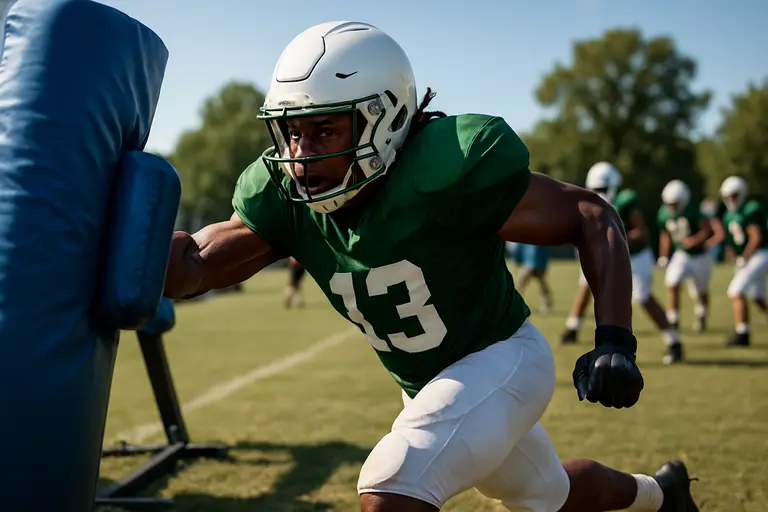
Woods’ research profile is compact but important. He appeared in all 12 games, started two, and recorded 28 tackles, 3.5 sacks, five tackles for loss, an interception and a fumble recovery. The supplied research also states that he co-led Florida in sacks and became the first true freshman to do so since 1992.
Defensive line production is often harder to appreciate than skill-position numbers because disruption does not always land in the stat sheet. Here, Woods has enough listed production to show visible impact. Sacks, tackles for loss, an interception and a fumble recovery point to a player who affected plays in multiple ways. That does not prove he is already a finished SEC defender. It does show why preseason voters would notice him.
The Gators All-SEC honors tied to Woods are especially interesting because defensive front play can raise the ceiling of an entire unit. If a line can create pressure without constant extra rushers, coverage calls become more flexible. If it can win early downs, third-and-long becomes more realistic. Those are structural benefits, not just individual accolades.
Why Defensive Recognition Travels Through The Roster
For Florida, a young defensive lineman gaining league notice can affect rotation planning. SEC offenses punish thin fronts, and players who can handle meaningful snaps early in their careers give coaches more room to manage fatigue. Woods’ all-12-game participation from the research suggests he was not a late-season cameo. He was part of the weekly defensive picture.
There is still uncertainty. The research does not provide snap counts, pressure rates, run-stop percentages or alignment data. Without those, it is better to avoid claims about whether Woods is best suited inside, outside or in multiple fronts. The verified takeaway is that his freshman production was broad enough to earn preseason attention and that Florida’s defensive front has a young player worth tracking closely.
Player Snapshot From The Verified Research
Three Different Paths To Recognition
| Player | Preseason Recognition | 2025 Research Notes |
|---|---|---|
| Jadan Baugh | Second Team RB; Third Team all-purpose | 1,170 rushing yards, eight rushing TDs, 31 catches, two receiving TDs |
| Vernell Brown III | Third Team return specialist | 40 catches, 512 receiving yards, 261 return yards |
| Jayden Woods | Third Team defensive lineman | 28 tackles, 3.5 sacks, five tackles for loss, interception, fumble recovery |
This snapshot shows why the recognition feels balanced. Baugh gives Florida proven offensive volume. Brown gives the roster a receiver-returner blend that can tilt field position. Woods gives the defense a young front-line producer. None of that guarantees a season outcome, but it does clarify why these three names are central to Florida’s preseason discussion.
What These Honors Mean For Gainesville Saturdays
Player Development Meets Local Identity
The Gators All-SEC honors matter because they connect individual development to the weekly experience around Florida football. Gainesville game days are built on more than the final score. They are shaped by whether the offense can stay on schedule, whether special teams can avoid lost yards, and whether the defense can create pressure moments that pull the crowd into the game.
Baugh, Brown and Woods each touch one of those pressure points. Baugh can steady possessions. Brown can alter starting field position and stretch defensive attention. Woods can bring disruption to a front that needs rotation strength across a long SEC season. The cautious read is also the most useful one: preseason honors give us a map of expectations, while the season will supply the proof.
For Florida’s local sports community, that is the real story. These honors do not need inflated language to matter. They already point to three players whose 2025 production gave voters a reason to pay attention, and whose 2026 roles could shape how the Gators look, feel and compete from Saturday to Saturday.