
Aaron Philo QB1 became Florida’s working answer at quarterback on August 24, 2026, when head coach Jon Sumrall named the Georgia Tech transfer as the starter for the Gators’ Week 1 season opener against Florida Atlantic on September 5, 2026 Florida’s announcement. The decision did not end the quarterback conversation in Gainesville. It did, though, give Florida a defined starting point for an offense being shaped by coordinator Buster Faulkner and a quarterback who already knows his system from two seasons at Georgia Tech.
For a program trying to create early offensive order, that matters. Philo’s resume is not built on a large college sample, and that should keep projections measured. His college numbers from Georgia Tech show some passing production, some mobility, and some risk with ball security. His high school profile, on the other hand, points to a passer who carried major volume in Georgia prep football. Florida’s choice is less about declaring a finished product and more about choosing the quarterback who appears best prepared to operate the full call sheet on day one.
Why Aaron Philo QB1 Was The Early Call
Aaron Philo QB1 And Scheme Familiarity
Sumrall’s public reasoning centered on readiness inside the offense. The Washington Post reported that Philo was more advanced in operating the full offensive scheme, helped by the fact that he followed Faulkner from Georgia Tech to Florida quarterback report. That is a practical explanation, not a grand prediction. Quarterback competitions often come down to who can get the huddle aligned, identify the correct answers before the snap, and keep the offense out of bad calls.
The Aaron Philo QB1 decision fits that frame. Faulkner’s 2025 Georgia Tech offense ranked 12th nationally in total offense at 466.3 yards per game, 31st in passing at 263.3 yards per game, and 19th in rushing at 203.0 yards per game, according to the research record. Philo’s value to Florida begins with familiarity: cadence, route timing, protection language, run-pass spacing, and the coordinator’s preferred answers against pressure. Those are not box-score stats, but they can shape how quickly an offense functions in September.
What Readiness Means Before Florida Atlantic
Florida’s opener against Florida Atlantic is scheduled for September 5, 2026, giving the staff less than two weeks between the public depth-chart call and kickoff. Naming a starter on August 24 gave Philo a clearer runway with the first-team offense. For receivers, backs, and linemen, that can help with timing. For the staff, it can narrow practice reps and reduce uncertainty around script-building.
There is still a cautious side to this. Scheme knowledge does not erase the difference between practice control and live SEC-level pressure. Philo has limited college starting experience, so Florida’s early offensive plan may need to protect him from unnecessary volume while still allowing him to use the parts of the offense he knows best. The first test is not simply whether he can complete throws. It is whether he can keep Florida on schedule, avoid rushed decisions, and make the offense look organized from the opening series.
The Numbers Behind The Transfer
Georgia Tech Workload And Risk Signals
Philo transferred to Florida in January 2026 after two seasons at Georgia Tech under Faulkner. In 2024 and 2025, he appeared in eight games, made one start, completed 59 of 102 passes for 938 yards, and threw two touchdown passes against three interceptions. His completion rate was 57.8 percent. He also recorded 16 carries for 95 yards and one rushing touchdown.
Those figures point in two directions. The passing yardage shows he has handled meaningful snaps, but the touchdown-to-interception line warns against treating him as a proven high-volume college starter. His rushing line suggests he can add movement value, yet there is not enough evidence to label him a run-first answer or a major designed-run threat. Florida’s staff likely knows more from practice than the public stat sheet shows, but the public data supports a restrained projection.
| Category | Verified Figure From Research | What It Suggests |
|---|---|---|
| Georgia Tech games | 8 appearances, 1 start | Some live experience, limited starter sample |
| Passing | 59-of-102, 938 yards | Production in short exposure |
| Scoring throws | 2 touchdowns, 3 interceptions | Decision-making still worth tracking |
| Rushing | 16 carries, 95 yards, 1 touchdown | Enough mobility to affect spacing |
High School Production Still Matters, But Carefully
Philo’s high school numbers are part of why his profile carries intrigue. He set Georgia state high school records with 13,902 career passing yards, breaking Trevor Lawrence’s previous mark, and threw 159 career touchdown passes. His senior season included 56 touchdown passes. Those are large numbers by any prep standard.
Still, college evaluation cannot stop at high school totals. The speed of post-snap rotations, the quality of defensive fronts, and the weekly pressure of the SEC create a different assignment. The proper reading is balanced: Philo has shown he can carry passing volume across his development path, but Florida’s 2026 offense will need evidence from live college Saturdays before the role can be judged with confidence.
What The Competition Says About Florida’s Quarterback Room
Tramell Jones Jr. Remains Part Of The Plan
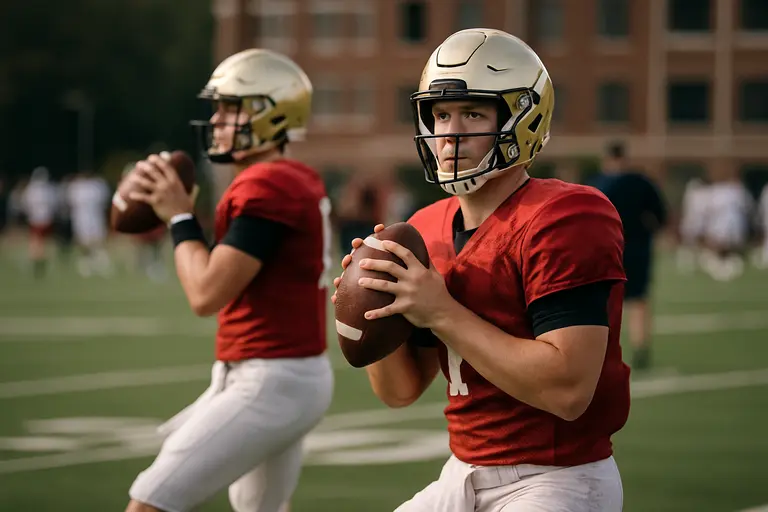
The Aaron Philo QB1 label did not remove Tramell Jones Jr. from the story. Jones, a redshirt freshman, was Philo’s primary competition. In 2025, Jones played in two games and completed 21 of 35 passes for 191 yards with two touchdown passes. Sumrall also emphasized that the decision was not permanent, with Jones remaining in the mix as the backup and still developing.
That matters for Florida’s roster depth. A quarterback room is rarely static across a full season, and public certainty in late August can change if performance, health, or practice growth shifts. Sumrall’s phrasing kept pressure on both players. Philo gets the first assignment, but Jones remains close enough to make weekly practice meaningful. For a team trying to build consistency, that competition can be healthy if it pushes preparation without splitting the locker room.
Spring Game Clues And Staff Trust
The April 11, 2026 Orange & Blue spring game gave an early public view of the race. Philo and Jones each threw touchdown passes, and Philo appeared first with the first-team offense. Spring games can be misleading because play-calling is selective and defensive plans are often limited, but the order of reps can signal how a staff views command at that point.
By August 24, that signal had become a formal decision. For local followers, Aaron Philo QB1 is not just a depth-chart note. It frames how Gainesville talks about the offense during the first week of September: how receivers settle into roles, how the offensive line handles communication, and how much of Faulkner’s system can be used without overloading the new starter.
What Aaron Philo Means For Gainesville Football
Local Stakes Beyond The Depth Chart
Florida’s quarterback choice always carries a community layer. Gainesville’s college football week is shaped by the Gators’ rhythm, from campus conversation to local business traffic around game days. A clear starter gives the fan base a name to study, but it also gives the offense a defined identity to test. Philo’s move from Georgia Tech to Florida in January 2026, paired with Faulkner’s arrival, makes this a player-development story as much as a transfer story.
There is a broader Florida angle, too. The Gators are asking a quarterback with Georgia high school roots and ACC experience to lead an SEC program. That blend is common in modern college football, where transfers can shorten the distance between scheme installation and game use. The key question is whether familiarity can produce clean execution against stronger weekly resistance.
What Should Be Measured First
The first public evaluation should be practical. Completion rate will matter, but so will drive quality, third-down choices, negative plays avoided, and whether Florida can keep the run and pass connected. Philo’s Tech rushing numbers suggest enough movement ability to help on designed movement or broken plays, yet Florida should not need him to become the whole offense for the plan to work.
The Aaron Philo QB1 story is best viewed as a starting point, not a verdict. Sumrall chose the quarterback who knew Faulkner’s system best and appeared most prepared to run it before the Florida Atlantic opener on September 5, 2026. The next layer is proof: clean operation, controlled aggression, and steady growth while Jones continues to push from behind. For Gainesville, that makes the opener less about hype and more about whether Florida’s offensive structure can show up quickly under a new starting quarterback.