The Florida Gators ranking reached a new point on Sunday, September 27, 2026, when Florida moved up 13 spots to No. 8 in the AP Top 25 after beating No. 4 Ole Miss 52-28 at Ben Hill Griffin Stadium. That was Florida’s highest poll position since 2020, and it came with a clean 4-0 overall record and a 2-0 mark in Southeastern Conference play, according to the Florida athletics report.
For Gainesville, this was not just a number beside a team name. Poll movement can change how a local fan base reads a season, how students talk about Saturdays on campus, and how families plan around game day. The ranking did not guarantee anything beyond September 27, 2026. It did, though, give Florida supporters the clearest public marker yet that the program’s early results had shifted national perception.
How The Florida Gators Ranking Changed The Room
What The Florida Gators Ranking Really Measures
The AP Top 25 is a perception tool as much as a scoreboard reflection. Florida’s rise to No. 8 came after two defining September moments: the 44-39 road win at Auburn on September 19, 2026, which helped the Gators enter the poll at No. 21 on September 20, and the 52-28 home win over Ole Miss on September 26. The second result carried extra weight because it was Florida’s first win over a top-five opponent since beating No. 5 Georgia in 2020.
That timeline matters. A one-week rise can be noise if it is built on a thin result. Florida’s case had more substance because the Gators first gained poll access after a road SEC win, then followed it with a convincing home result against a top-five opponent. That does not remove the pressure of the remaining schedule, but it explains why voters reacted quickly.
That Florida Gators ranking also changed how the Ole Miss game will be remembered locally. It was not only a home win. It became the win that gave fans a tangible sign of movement from outside the building. Programs often talk about progress internally, but poll movement makes that progress public.
The On-Field Evidence Behind The Jump
The score line against Ole Miss was loud, but the way Florida built it was just as meaningful. The Gators rushed for 302 yards on 52 carries. Jadan Baugh ran for 142 yards and three touchdowns, while Duke Clark added 126 yards and one score. In a sport where program identity is often tied to line play and late-game physicality, that rushing profile gave the result more staying power than a narrow upset would have.
The offensive balance suggested that Florida did not need one isolated play to pull the game away. A 52-point performance against a top-five opponent gave fans plenty to celebrate, but the ground-game totals offered a more practical coaching takeaway: Florida controlled enough downs to keep pressure on Ole Miss across the full game. That is the kind of detail poll voters tend to reward because it points to repeatable traits, not only momentum.
Why The Swamp Felt Bigger Than One Game
A Sellout Streak With Community Meaning
Ben Hill Griffin Stadium drew 90,683 fans for the Ole Miss game on September 26, 2026. The crowd was listed as a sellout and marked the 21st consecutive sold-out game under current ticketing. Two weeks earlier, the September 12 home game against Campbell marked the 20th straight sellout, which was noted as Florida’s longest such run since a 138-game stretch from 1989 through 2011.
Those attendance figures are more than background color. They show that local support had already been strong before the national jump. The No. 8 ranking did not create the crowd from nothing; the crowd helped frame the win as a Gainesville event. For students, alumni, local businesses, and families traveling into town, the sellout streak showed a level of commitment that had survived the weeks before the poll rewarded Florida.
That is where college athletics feels different from a neutral-site sporting event. A full Swamp affects traffic patterns, campus movement, restaurant demand, and the rhythm of a Saturday in Gainesville. We should be careful not to assign dollar amounts without verified local economic data, but the practical effect of more than 90,000 people gathering around one game is plain enough. The team’s result and the community’s turnout reinforced each other.
Fan Reaction Became Part Of The Story
After the Ole Miss win, fan reaction moved quickly across social platforms. Yahoo Sports collected responses that included “I honestly cannot believe what I’ve seen,” “We are so back,” and “We’re back, baby!!” after the statement win over Ole Miss Yahoo Sports fan reaction. Those comments were emotional, but they also revealed something useful: expectations had changed.
College football communities often process success in public. A ranking gives structure to that emotion. The posts after September 26 did not prove what Florida would become in October or November, but they showed a fan base ready to reframe the team’s direction. That matters for home-field energy, recruiting conversations, alumni engagement, and the daily sports talk that fills Gainesville after a major win.
The Local Stakes Behind No. 8
Ranking Pressure Meets Gainesville Identity
The Florida Gators ranking placed the program back near the national front, but the sharper local question is how a team handles that attention. A No. 8 spot changes the week-to-week conversation. Opponents see a bigger target. Fans expect cleaner football. Mistakes feel more costly because the national poll has already declared Florida relevant.
That is not a bad problem. It is the kind of pressure many college programs chase. Still, the cautious read is the fair one: Florida’s September 2026 résumé was strong, but it was still a September résumé. The Gators had earned praise through a 4-0 start and two SEC wins by September 27, yet the ranking was a checkpoint rather than a trophy.
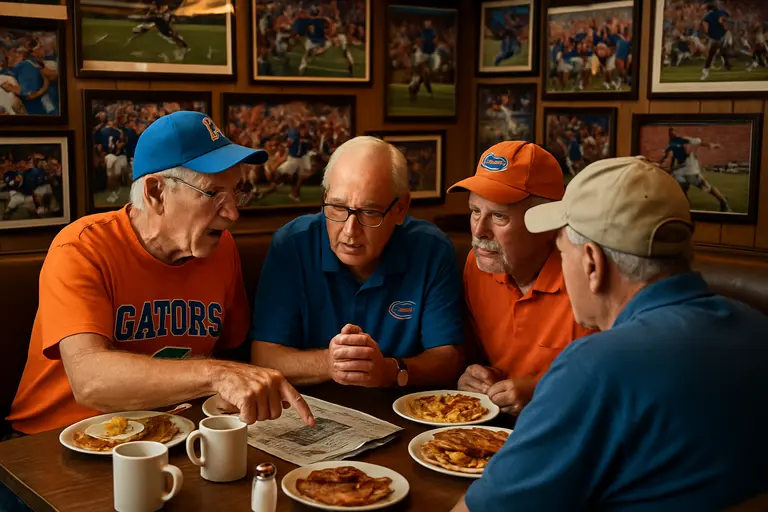
For Gainesville, the benefit is immediate even if the season’s full shape remained unsettled as of September 28, 2026. Students had a shared reference point. Alumni had a reason to reconnect. Local conversations had fresh energy rooted in a verified result, not rumor. That is the community value of a major poll move: it gives people a common sports language for the week.
- Competitive signal: Florida beat a top-five opponent by 24 points on September 26, 2026.
- Community signal: The Swamp recorded 90,683 fans and extended a sellout streak.
- Fan signal: Public reaction showed renewed belief after years without a ranking this high.
Why The Rushing Output Resonated
Florida fans have seen plenty of explosive plays through the years, but the Ole Miss win connected with the community because the production looked sturdy. Rushing 52 times for 302 yards is not a cosmetic stat. It suggests patience, line push, backfield depth, and a coaching staff comfortable leaning into a strength.
Baugh and Clark gave the game a player-development angle, too. In college football, local belief often grows when fans can attach the rise of the team to the rise of specific athletes. A poll number is abstract. A back breaking tackles in front of a full student section is not. That is why the No. 8 ranking landed with more force after such a visible ground-game performance.
Why Florida Gators Ranking Matters In Gainesville
The Florida Gators ranking mattered because it tied together three threads that local sports communities care about: results, presence, and belief. Florida had the results through September 27, with a 4-0 record and a top-five win. It had the presence, shown through another sellout at Ben Hill Griffin Stadium. It had the belief, shown through fan reaction that moved from surprise to optimism in a matter of hours.
None of that should be stretched into certainty about what came next after September 28, 2026. The stronger point is more grounded: Florida gave Gainesville a week where the numbers and the noise lined up. No. 8 in the AP poll was not the end of the story, but it was a meaningful public measure of how far the Gators had climbed by late September.
For a college town, that kind of moment carries weight. It fills radio segments, student conversations, family group chats, and pregame plans. It reminds everyone why Saturdays at the Swamp can feel personal. The ranking belonged to the team, but the impact reached well beyond the sideline.