
Florida Poly recruiting changed meaning in 2026. For years, the Lakeland STEM university could sell academics, location, and a distinct campus identity, but it could not offer varsity competition. That changed when Florida Polytechnic University announced on March 10, 2026, that it would begin collegiate athletics in Fall 2026 with eight varsity sports: men’s and women’s soccer, cross-country, basketball, plus baseball and softball university announcement.
As a scout, I read this launch less as a quick roster story and more as a player-development test. The early question is not whether Florida Poly can sign athletes. It is whether the school can identify students who fit the academic load, accept a start-up athletic environment, and help establish daily standards before the program has years of results to sell.
The available record through October 15, 2026, shows a cautious but active build. The university appointed Derek Lower as its first Director of Athletics on April 13, 2026. His responsibilities included hiring coaches, recruiting student-athletes, and setting up the department structure. By August, the first soccer and cross-country teams had been introduced at media day, and fall competition had already begun.
Florida Poly Recruiting Enters Varsity Play
Florida Poly Recruiting Timeline
The timeline moved quickly. The public launch came on March 10, 2026. Lower’s hiring followed on April 13. Stephanie Bylander was announced on April 23 to lead men’s and women’s cross-country after 11 years at Florida Southern and with local recruiting connections. Jack Paris was announced on May 11 as women’s soccer head coach after previous stops at Webber International and Eckerd.
Those dates matter because new programs often lose time before they gain trust. A coach hired late has fewer evaluation windows, less time to contact families, and less room to explain admissions expectations. Florida Poly had to build rosters while also explaining what varsity athletics would look like at a STEM-focused institution with no prior varsity track record.
Eight Sports Changed The Recruiting Pitch
The university initially planned six sports, the minimum needed for NAIA membership consideration, then expanded to eight by adding men’s and women’s basketball after feedback from high school guidance counselors. That detail is useful because it points to demand from families and school staff, not just internal ambition.
Florida Poly said the athletics initiative could attract up to 150 student-athletes annually. That figure should be treated as a program target, not proof of immediate competitive depth. Still, it signals a material enrollment and campus-life shift for a university that previously missed some prospects because it lacked varsity athletics. In recruiting terms, the school moved from a purely academic pitch to a dual-identity pitch: STEM degree plus college competition.
Academic Fit Shapes The Athlete Pool
STEM Fit Over Scholarship Flash
The most important filter may be academic. The launch did not center on full-ride scholarships typical of higher NCAA divisions. Reporting on the recruiting approach noted that prospects needed interest in STEM and the ability to handle Florida Poly’s academic demands, with no plans for full-ride scholarships at the start recruiting report.
That narrows the pool but can sharpen the fit. A player who wants a softer academic path is unlikely to match the program. A high school athlete who is serious about engineering, technology, or related fields may see value in a place where athletics is new but the academic identity is clear.
For evaluators, this changes the checklist. Speed, size, skill, and competitive background still count. So do transcript strength, study habits, and willingness to join a roster that may take time to mature. Florida Poly recruiting is therefore less about chasing the biggest name and more about matching the right athlete to the right workload.
Transfers And International Additions
The fall 2026 recruiting class included incoming freshmen, junior college transfers, and international players, with women’s soccer offering a clear example. The target roster for women’s soccer in year one was about 15 to 16 players. Other programs aimed higher, including basketball at about 28 players.
That mix is logical for a first-year department. Freshmen offer long-term development. Junior college transfers can bring age and match experience. International players can widen the talent base, especially in soccer. The risk is cohesion. Players arriving from different systems need clear standards, repeated communication, and stable training habits.
Roster size also deserves a careful read. A small first-year soccer roster can create playing-time opportunity, but it can also test depth during travel, class pressure, and normal wear across a season. A larger basketball target can help internal competition, but it also requires role clarity. In a new program, the best recruiting wins may be players who accept uncertainty without drifting from team goals.
Coaching And Venue Choices Affect Local Pipeline
Regional Coaches Give Early Reach
New programs rarely begin with broad national recognition. That makes coaching networks valuable. Bylander’s Lakeland-area experience and Paris’ background at Florida college programs gave Florida Poly immediate regional credibility. Those ties do not guarantee signings, but they can help open calls with high school coaches, club directors, and families who want to know whether the new program is organized.
From a scouting standpoint, local knowledge is practical. Central Florida players are not all evaluated at the same events. Some come through school competition, some through club soccer, some through distance running circuits, and some through junior college routes. Coaches with regional experience can reduce the chance of missing late-developing athletes who also fit the STEM profile.
Auburndale Venues Give Recruits A Home Base
Facilities can decide whether a new program feels temporary or serious. On July 21, 2026, Florida Poly and the City of Auburndale formalized a three-year agreement, with a two-year option, for the use of Lake Myrtle Complex, Auburndale Softball Complex, and the Auburndale Community Center for games and practices. The fee was $50,000 per year. The arrangement began supporting the inaugural men’s soccer match on August 13.
For recruits, that matters. A defined home environment helps families picture match days, training routines, and travel patterns. It also gives coaches a more concrete pitch than “facilities are coming.” For local businesses and youth sports families, the agreement ties the university’s athletic identity to existing Central Florida sports infrastructure.
There is still a planning challenge. Using off-campus or partner venues requires schedule discipline, transportation planning, and steady communication with athletes. Those are not minor details for STEM students managing labs, projects, and travel. If handled well, the venue plan can support retention. If handled poorly, it can add friction.
Community Impact Across Lakeland And Auburndale
What Families Can Measure
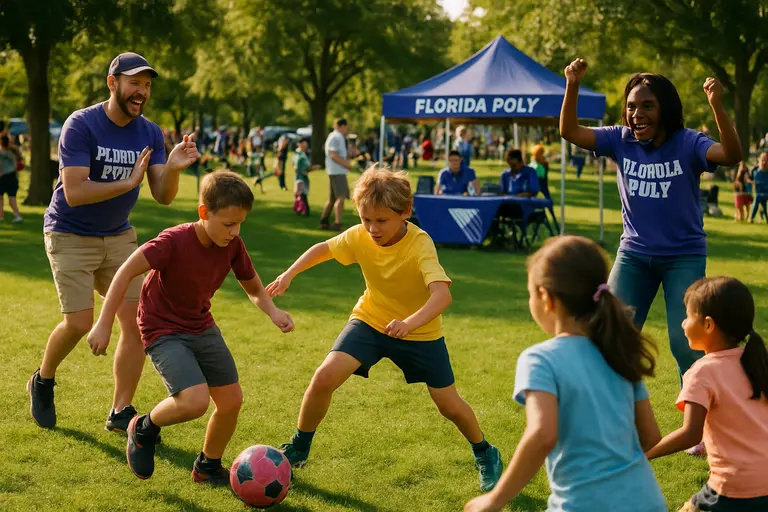
The inaugural athletics media day was held on Monday, August 10, 2026, and introduced the men’s and women’s soccer and cross-country teams. That event had recruiting value because it made the athletes visible and gave the program a public face. For families considering future classes, seeing real teams in place matters more than hearing a concept.
By Fall 2026, all eight sports were active or launching varsity competition. The women’s soccer schedule included a match against New College of Florida on August 20, and the men’s soccer schedule included New College on August 29. Cross-country meets were scheduled for early September. Those dates now belong to the first chapter, not a future plan.
Why Roster Growth Needs Patience
Community expectations should be measured. First-year teams often face uneven results, thin depth, and identity shifts. That is normal when athletes are being recruited into a structure that did not exist a year earlier. The better question is whether athletes stay enrolled, improve physically and technically, and speak positively about the balance between sport and academics.
Florida Poly recruiting will also affect nearby high schools. A STEM-focused varsity option in Lakeland gives guidance counselors and coaches another pathway for students who want college competition without giving up an academic direction. That does not replace established Florida programs. It adds a different fit, especially for athletes who may have been overlooked by larger departments or who want a smaller academic environment.
- Most relevant recruiting signal: whether student-athletes can handle STEM coursework while staying committed to training.
- Most relevant community signal: whether local coaches view Florida Poly as a credible destination for academically strong athletes.
- Most relevant roster signal: whether early transfers, freshmen, and international players form stable team cultures.
Florida Poly Recruiting And The First Varsity Class
A Scout’s Cautious Read
The first varsity class should not be judged only by wins. It should be judged by fit. Did the athletes choose Florida Poly for reasons that can hold up after the first hard travel week or demanding exam period? Did coaches recruit players who understood the start-up stage? Did the department provide enough structure around venues, schedules, and communication?
From the facts available through October 15, 2026, the launch has several sound building blocks: eight sports, an athletics director hired before the first fall season, regional coaching ties, a venue agreement in Auburndale, and an academic pitch that clearly separates Florida Poly from many traditional athletic departments. There is still uncertainty around long-term retention, competitive level, and roster depth across all eight sports. Those outcomes need seasons, not slogans.
For Florida families, the practical takeaway is clear. Florida Poly recruiting has created a new college option for athletes who want STEM academics and varsity competition in Central Florida. The opportunity is real, but it is best suited for recruits who understand that building a program requires patience, resilience, and daily habits that match both the classroom and the training field.