
The Buchholz Santa Fe rivalry returned on October 1, 2026, and it gave Alachua County a clear reminder of why local high school football still carries weight beyond the scoreboard. Buchholz defeated Santa Fe 35-10 in Alachua, Florida, in a non-conference matchup at Santa Fe’s home stadium, marking the teams’ first meeting since 2020, according to the MaxPreps recap. The game, known locally as the “War on I-75,” was not just a win for the Bobcats. It was a measuring point for two programs, two school communities, and a county that treats Friday night football as a shared civic event.
For Buchholz, the result reinforced a high standard already visible in its unbeaten record at that point. For Santa Fe, the loss did not erase the strong start that brought the Raiders into the matchup undefeated. Rivalries often carry that kind of double meaning. One team gets the result, but both programs get a sharper view of where they stand under pressure, especially when the opponent is close enough for the game to feel personal.
Buchholz Santa Fe Rivalry Reset On October 1
Buchholz Santa Fe Rivalry By The Numbers
The numbers from October 1 showed why Buchholz controlled the second half. The Bobcats scored in every quarter: 7 points in the first, 14 in the second, 7 in the third, and 7 in the fourth. Santa Fe scored 7 in the first quarter and 3 in the second, then was held scoreless after halftime. That split matters because it points to sustained execution rather than one short burst. A rivalry game can swing on emotion early, but the stronger team usually separates when possessions become more disciplined.
Quarterback Andrew Whittemore, a junior, completed 11 of 16 passes for 263 yards, 3 touchdowns, and 1 interception. Junior running back Josh Menefee carried 27 times for 187 rushing yards and 2 touchdowns. Senior wide receiver Dominick Harvey caught 5 passes for 213 yards and all 3 receiving touchdowns. Those three stat lines give the Buchholz offense balance: efficient passing, heavy rushing volume, and an explosive target who turned limited receptions into major field position changes.
The most telling part was not only the yardage total. It was how those yards arrived. Buchholz had enough success through the air to stretch Santa Fe, then enough rushing production to keep drives from becoming one-dimensional. In high school football, that mix can be hard to defend because it asks linebackers and defensive backs to process run fits and deep coverage without much margin for hesitation.
What The Score Said About Game Control
WRUF reported that Buchholz improved to 7-0 with the win, while Santa Fe fell to 5-1 after the matchup WRUF report. That context matters. This was not a case of a struggling team overwhelming a rebuilding opponent. It was a meeting between two teams that had earned early-season confidence, which makes the 25-point margin more meaningful.
The Buchholz Santa Fe rivalry also offered a useful lesson about finishing halves. Santa Fe stayed within reach early and had defensive resistance before halftime, but Buchholz’s ability to add points across all four quarters placed constant stress on the Raiders. The second-half shutout was the clearest football detail in the final score. It showed that Buchholz adjusted well enough to close the door, while Santa Fe could not regain the offensive rhythm it found in the opening half.
Explosive Plays And Player Development
Harvey’s Big-Play Value
Dominick Harvey’s production shaped the night. WRUF reported that the opening score came on a 71-yard touchdown pass from Whittemore to Harvey early in the first quarter. Harvey also scored on an 11-yard screen and a 46-yard catch. Those plays came in different forms, which is the key detail for player development. A deep touchdown stresses vertical coverage. A screen asks a receiver to create after the catch. A mid-range explosive catch requires timing, separation, and finishing speed.
For Buchholz, that type of receiver usage makes the offense less predictable. For Harvey, the performance gave evaluators and local observers a clear sample of production in a rivalry setting. One game should not be stretched into a full scouting profile, but rivalry games can reveal how players respond to pressure, crowd energy, and defensive attention.
Santa Fe’s Defensive Response
Santa Fe had moments that should not be lost in the final margin. Sophomore linebacker Marzavious Ross intercepted a pass in the end zone with 38 seconds left before halftime, preventing Buchholz from expanding the lead before the break. That play mattered because it gave the Raiders a chance to regroup rather than absorb a deeper halftime deficit.
In rivalry football, those moments help define a program as much as the final score. Santa Fe did not win the game, but a young defender making a red-zone play against a productive offense is still a development marker. It is also the kind of moment coaches can carry into film review: proof of assignment discipline, ball awareness, and refusal to concede a scoring chance.
The Buchholz Santa Fe rivalry benefits from those individual flashes. The headline belonged to Buchholz’s offensive trio, and rightly so. Yet the county-wide value of this matchup grows when both programs produce players who can handle meaningful snaps in front of a local audience.
Why This Rivalry Matters In Alachua County
A Local Measuring Stick
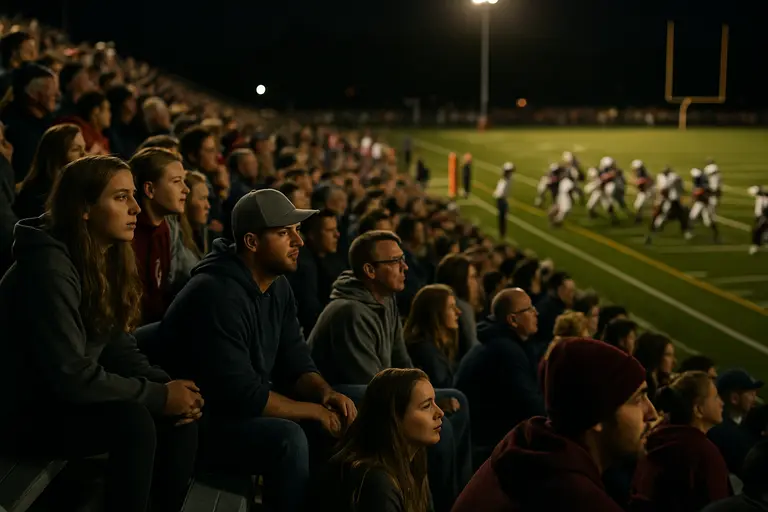
High school rivalries are not only about records. They set standards inside a local sports community. Buchholz and Santa Fe are close enough for the game to carry natural regional interest, and the “War on I-75” label gives the matchup an identity that players can understand quickly. When a game has a name, it becomes easier for students, alumni, and families to place it on the calendar as something more than another regular-season date.
That identity also creates pressure. Buchholz entered the game unbeaten and left unbeaten. Santa Fe entered unbeaten and left with its first loss. Those facts are simple, but their effect is broader. Buchholz gained confirmation that its approach held up in a rivalry setting. Santa Fe received a clear test against a team that punished mistakes and finished drives. Both outcomes can shape practice habits after the game, especially for players still learning how fast the margin can shift against a strong opponent.
This is where the Buchholz Santa Fe rivalry fits the larger story of Florida high school football. Local matchups build memory from one class to the next. They also place players in environments that feel different from ordinary games. For more on how these games shape communities across the state, our piece on Florida high school rivalries connects the football field to families, travel, and local pride.
Community Pride Without Empty Hype
It is tempting to turn every rivalry result into a sweeping claim, but the safer read is also the more useful one. On October 1, 2026, Buchholz was the better team. The Bobcats executed with balance, hit explosive plays, and controlled the second half. Santa Fe showed enough early offense and defensive resistance to create teachable film, but it did not sustain scoring after halftime.
That distinction matters for the community. Pride is not limited to winning. It also comes from seeing young athletes compete in a setting that carries school identity, local attention, and real performance stakes. The field becomes a place where underclassmen learn, seniors lead, and coaches get honest feedback.
Why The Buchholz Santa Fe Rivalry Matters Locally
The Buchholz Santa Fe rivalry mattered on October 1 because it gave Alachua County a clear, recent chapter in a matchup that had been dormant since 2020. Buchholz’s 35-10 win will stand as the central result, but the deeper value sits in what the game revealed: Whittemore’s efficiency, Menefee’s workload, Harvey’s explosive receiving night, Ross’s end-zone interception, and Santa Fe’s need to turn early competitiveness into four-quarter staying power.
For a local sports community, that is the heart of a rivalry. The scoreboard records the outcome. The film shows the teaching points. The stands, school hallways, and practice fields carry the meaning forward. In that sense, the October 1 renewal did more than settle one game. It gave both programs a sharper reference point for who they were on that date, and why this county matchup still earns attention.