The Miami No. 1 Ranking did more than move the Hurricanes to the top line of a national poll. It altered how Florida’s college football hierarchy is being discussed after Miami’s 43-35 double-overtime win over Florida State on October 17, 2026. The AP Top 25 released on October 18 placed Miami at No. 1 for the first time since December 8, 2002, with the Hurricanes listed at 6-0 overall and 4-0 in ACC play, according to the NCAA AP poll report. In a state where brand power, recruiting access, and rivalry memory often overlap, that single ranking changed the tone around Miami, Florida State, and Florida.
The shift is not just symbolic. Miami’s win came against its central in-state rival, in a game decided late, with enough individual production to shape recruiting conversations for months. Darian Mensah threw for 326 yards and three touchdowns. Malachi Toney caught 11 passes for 154 yards and two touchdowns, then added a two-point conversion catch. Bryce Fitzgerald sealed the game with an interception. Those details matter because rivalry games in Florida are rarely judged only by the scoreboard. They become arguments about program direction, player development, and which campus appears closest to the sport’s national center.
Miami No. 1 Ranking And The FSU Standard
Miami No. 1 Ranking Turns A Rivalry Win Into A State Marker
For Florida State, the October 17 loss carried more weight than a narrow defeat. Miami did not just beat the Seminoles; it used the result to claim the top spot in the AP poll the next day. That timing sharpens the rivalry because future meetings are now framed through a different lens: Florida State is not merely trying to win a familiar series, but trying to pull down the in-state program that reached No. 1 after beating it.
The rivalry’s record was already tight entering the game, with Miami holding a narrow 37-33 all-time edge since 1951. The series has also been defined by margins that keep both fan bases emotionally invested. Research notes show that 18 of the previous 25 meetings before October 17 had been decided by eight points or fewer. The double-overtime result fit that pattern, but the poll movement gave it a larger afterlife.
Why Close Games Change Public Perception
Florida State can reasonably point to the closeness of the game as evidence that the gap is not as wide as the ranking suggests. Yet perception often moves faster than caution allows. Miami left that night with a win, a clean record, and the No. 1 label within 24 hours. The Seminoles left with proof of competitiveness but not the result needed to slow Miami’s state narrative.
That distinction matters in Tallahassee, where rivalry losses affect more than message-board mood. They influence how donors, former players, recruits, and local businesses talk about program direction. A tight loss to a top-ranked Miami team can be respected nationally, but within Florida it still gives the Hurricanes the stronger bragging position. For a deeper rivalry-specific angle after the Miami Gardens game, our related analysis of the FSU-Miami state prestige stakes tracks how the series continues to shape local identity.
Recruiting Pressure Across South Florida
Showcase Games Carry Real Weight
The recruiting impact may be the most practical part of the Miami No. 1 Ranking. Miami used the Florida State game as a high-visibility showcase for in-state prospects. Research notes indicate that Miami’s current in-state commitments are all from South Florida or its surrounding area, and many high school prospects attended the Florida State matchup. That does not guarantee future signatures, but it gives Miami a timely argument: elite recruits did not have to leave the region to see a top-ranked team on a major rivalry stage.
Florida recruiting is local, competitive, and deeply relationship-based. Coaches from Miami, Florida State, and Florida all work the same high school corridors, especially in South Florida, Tampa Bay, Orlando, Jacksonville, and the Panhandle. A No. 1 ranking does not replace position fit, playing time, academics, or name-image-likeness considerations. It does, however, strengthen Miami’s first impression in living rooms and at high school sidelines.
The Local Pipeline Question
South Florida has long produced players capable of shifting national title races. When Miami is winning at the top of the poll, that pipeline becomes a public story again. For prospects, the message is not abstract: stay close, play in front of family, compete for a program viewed nationally as No. 1, and do it in a rivalry environment that still commands attention across the state.
Florida State and Florida still have recruiting strengths that Miami’s poll position does not erase. FSU can sell immediate rivalry payback and ACC familiarity. Florida can sell SEC schedules, Gainesville’s player development pitch, and a different week-to-week competitive structure. The key change is that Miami now enters those conversations with fresh proof rather than nostalgia. The December 8, 2002 reference point matters because Yahoo Sports reported that this was Miami’s first AP No. 1 ranking since that date, before the BCS title game loss to Ohio State, according to Yahoo Sports.
Florida Gators Feel The Perception Gap
UF At No. 20 Is Respectable, But Not Equal In The Poll
The University of Florida sat at No. 20 in the AP poll released on October 18, after a 5-2 record and a win over Texas. That standing is not minor. It places Florida in the national conversation. Still, the distance between No. 1 and No. 20 affects public perception, especially in a state where comparisons are constant and often unforgiving.
For UF, Miami’s rise creates a different kind of pressure than the one facing Florida State. The Gators were not the team Miami beat to reach No. 1, but they are part of the same statewide argument. In Gainesville, the question becomes whether SEC exposure can offset Miami’s current poll position in recruiting and public attention. For some recruits, playing in the SEC remains a major draw. For others, Miami’s undefeated start and top ranking may feel more immediate.
A Less Frequent Miami-Florida Series Raises The Stakes
The Florida-Miami series has become less frequent, which makes each meeting carry more emotional weight. Research notes show Miami leads the all-time series 31-27, but the teams have played only nine times since 1987 because of scheduling changes. That scarcity changes how fans process the rivalry. Unlike Miami-FSU, which has a steadier modern rhythm, Miami-Florida often arrives with built-up nostalgia and sharper debate about which program better represents the state.
That scarcity also affects young fans. A student in Gainesville or Coral Gables may know the rivalry through family stories as much as personal game-day memory. When Miami reaches No. 1, the older rivalry gains fresh relevance because it gives both fan bases another way to measure the present against the past. The Gators do not need Miami on the schedule every year for the comparison to matter. Poll placement, recruiting overlap, and state pride keep the argument active.
How Rankings Shape Rivalry Intensity
Rankings Become Short-Hand For Program Health
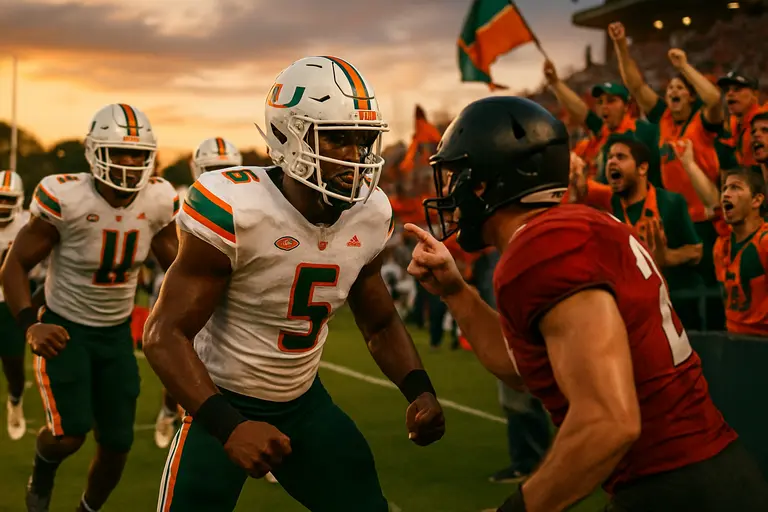
Polls are imperfect, and any cautious analysis has to say so. The AP Top 25 is not a final judgment on a roster, a coaching staff, or a season. It is a weekly snapshot. Yet snapshots matter in college football because they become easy language for complicated debates. The Miami No. 1 Ranking now functions as short-hand for Miami’s current advantage in the Florida conversation.
That advantage is not permanent. A ranking can change after one loss. Injuries, schedule strength, road fatigue, and late-season execution can alter the national view quickly. But as of the October 18 poll, Miami owned the state’s loudest claim. That affects how media frames press conferences, how opposing coaches discuss preparation, and how fan bases set expectations.
Community Impact Beyond The Stadium
Rivalry status also reaches outside football facilities. In Miami-Dade, Broward, Palm Beach, Tallahassee, and Gainesville, college football success feeds local conversations in restaurants, barber shops, alumni events, and high school bleachers. A No. 1 Miami team gives South Florida a civic sports talking point at a time when recruiting and local identity are closely linked.
For Florida State communities, the result creates frustration but also a clear target. For Gator fans, it raises the urgency around remaining visible in a state where three major programs compete for attention. For high school athletes, it makes Florida’s college football map feel more contested. Miami’s ranking does not reduce FSU or UF to side characters, but it forces both programs to answer a sharper question: how quickly can they match the standard Miami has claimed in public?
What Miami No. 1 Ranking Means For Florida
The State Race Is Now More Direct
The Miami No. 1 Ranking gives the Hurricanes the strongest current claim in Florida college football, but the claim comes with scrutiny. Every close win will be examined. Every recruiting weekend will be interpreted. Every comparison with Florida State and Florida will carry the added pressure of No. 1 status. That is the cost of reaching the top of the poll.
For Miami, the immediate task is to keep turning ranking pressure into weekly performance. For Florida State, the October 17 result becomes both a wound and a reference point: close enough to compete, not finished well enough to own the state argument. For Florida, the challenge is different but just as real. The Gators must defend their national relevance while a South Florida rival holds the highest AP ranking.
Florida college football has always been shaped by more than records. It runs through recruiting corridors, family allegiances, alumni pride, local economies, and memories of games decided by a field goal, a turnover, or an overtime throw. Miami’s rise to No. 1 on October 18, 2026 did not settle those rivalries. It changed their terms, and every major program in the state now has to respond.