
What do you think of when you hear Florida HS to college pipeline? Maybe Publix or hanging chads come to mind. But for college basketball fans, it’s about top talent from Montverde Academy and IMG Academy.
These schools aren’t just making players; they’re creating stars. Every year, new freshmen bring excitement and surprises. Coaches might not always tell the truth, and betting lines are based on highlights, not real games. This is where smart betting comes in.
Freshmen can be wild on the court. They might be strong but lack experience. This article will help you understand where to find these Florida HS recruits for props and DFS. If you’re not watching these freshmen, you’re missing out.
Top incoming recruits landing spots archetypes and likely roles
Every summer, high school basketball in Florida brings new talent. The names sound like they’re from a video game. But the real question is, will they play in the first ten games?
A McDonalds All American from Florida, a wing player from Montverde, is headed to a top program. He looks like a future NBA star. But will he get to play, or will a senior point guard control the game?
Archetypes play a big role. Here’s what to look for:
- Catch-and-shoot specialists from IMG Academy could be a great bet if they join a team that needs spacing.
- Rim-running bigs from West Oaks Academy might be good for DFS if their team plays fast and the coach lets them play.
- High school stars often find themselves in supporting roles early on. It’s a chance to prove themselves.
We’ll look at the top Florida freshmen, their roles, and how they might start strong. Knowing a five-star point guard might actually be a combo guard can help you win. For more, check out this detailed analysis.
Translation factors coach trust defense rebounding and foul rates
In sports betting, usage translation is key for prop bets success. It’s not just about high school stats. It’s about how those stats translate to college. Some freshmen dominate in high school but struggle in college.
Why? Because their coach might not trust them. This lack of trust can greatly affect a player’s performance.
Coach trust is vital. Some coaches prefer walk-ons over top recruits if they don’t fit their system. This can hurt your bets more than you think.
Defense and rebounding are also important. A player who excelled in high school might not play much in college. This is because college coaches value these skills over scoring.
Foul rates are another factor. Freshmen from aggressive AAU circuits often get into foul trouble. I’ve seen a top player play just 11 minutes in a big game because of fouls.
So, I look at more than just points and assists. I also check fouls per 40 minutes and defensive ratings. This helps me understand how a player will perform in college.
Translation isn’t simple. It’s complex and often misunderstood by books. Knowing this helps you make better bets in college basketball.
Early season tournaments prop windows before books adjust
November and December bring a busy time for college basketball betting fans. Tournaments like the Maui Invitational and the Battle 4 Atlantis are big events. Sportsbooks are fine-tuning their predictions, and freshmen players are under the spotlight.
This is when the prop window is open before the market adjusts. I remember a Florida guard, a top-50 recruit, scoring 25 points in a Thanksgiving tournament. The opposing team’s strategy was simple: let him shoot. By January, his points prop had jumped by 4.5 points, and the value was gone.
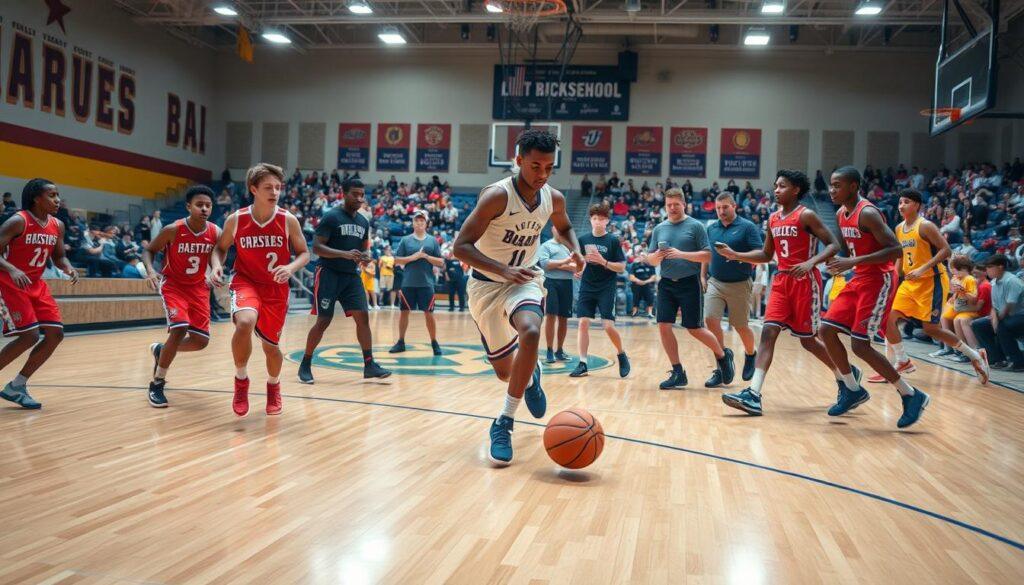
During these tournaments, usage translation happens fast. A freshman playing 70% of minutes in a game against a ranked team sends a strong message. It shows the coach trusts him or the bench is struggling. Either way, it’s useful information.
I watch early season rotations closely, looking at which Florida high school recruits play big roles. Sportsbooks are slow to adjust because they rely on preseason predictions from August. These predictions are often based on incomplete information.
By the time conference play starts, the market gets efficient. But in those early weeks, you can find props with low implied usage. That’s not just betting—it’s finding great deals.
DFS cheap tag strategy minutes projection vs ceiling
In DFS, a cheap tag can be your golden ticket. This is true when it’s paired with a solid minutes projection. Finding a $4,200 freshman on DraftKings projected for 25 minutes is like stumbling upon a hidden treasure. But remember, “projected” is the key word here. The science of minutes projection for freshmen often feels like a mix of analytics and a game of chance.
When assessing a player’s ceiling, you need to weigh several factors:
- Coach’s Comments: What are they saying about the player’s role?
- Injury Reports: Are there any key players missing that could open up minutes?
- Opponent’s Pace: How fast does the opposing team play?
The threat of redshirt risk becomes apparent. This isn’t about the official redshirt status—rare for top Florida recruits—but the functional redshirt. It’s when a talented freshman gets lost in the shuffle, only seeing the court during garbage time. I’ve seen five-star recruits touted as “too talented to sit” who ended up logging just 8 minutes a night due to defensive liabilities.
The tension between ceiling and floor is a constant in DFS. A freshman with a 30-point ceiling but a 4-point floor is a risky GPP play. On the other hand, a steady 20-minute role player can anchor your cash game lineup. To build winning lineups, I reverse-engineer the rotation:
- Who’s the first sub off the bench?
- Who plays alongside the starters in crunch time?
The Florida pipeline churns out high-ceiling, low-floor freshmen. Their undeniable talent often comes with raw fundamentals, making them volatile options. Embrace this volatility with proper bankroll allocation, which we’ll explore later. Understanding the dance between ceiling and risk is essential for DFS success.
Fade signals coach quotes load management class absence
In college basketball, coaches often speak in riddles. This leaves us trying to figure out what they really mean. When a coach says a freshman is “coming along nicely,” it usually means he won’t play until February. It’s key to understand coach speak to know when a player is ready.
Load management is a big deal in sports, but in college, it often means “he got hurt in practice.” This caution can last from three games to three months. In college basketball, that’s a long time.
Class absences are another important fade signal. Remember, these athletes are students first. If a Florida freshman misses classes, he’s close to being suspended. Programs like UM’s Summer Scholars help, but not all have this chance.
To stay ahead, I watch beat writer tweets for clues. Phrases like “didn’t practice due to academic obligations” or “coach mentioned he needs to be more responsible off the court” are big red flags. When I see these, I fade that player’s props and look for the backup.
Understanding these signals is not just about being cynical. It’s about reading the signs before they become big news. Here’s a quick guide to these fade signals:
| Signal Type | Description | Potential Impact |
|---|---|---|
| Coach Quotes | Vague praise often indicates limited playing time. | Higher fade risk for player props. |
| Load Management | Indicates caution due to possible injury. | Possible absence from games. |
| Class Absences | Missing classes can lead to academic penalties. | Increased risk of suspension. |
Injury and academic clearance watch
Florida HS recruits face big challenges when moving to college sports. They must deal with injuries and getting cleared academically. A sudden injury can ruin a bet fast, as coaches keep injury news secret.
College basketball is often shrouded in mystery. We might find out about injuries through social media. For Florida HS recruits, injuries from AAU games can follow them to college.
Academic clearance is also a big hurdle. The NCAA Eligibility Center can be tough to navigate. Some freshmen miss games because of academic issues.
Programs like the University of Miami Pre-College help with this. But not all recruits have such support. I keep track of freshmen with eligibility issues over the summer.
If a recruit isn’t cleared until August, I doubt their early-season play. A starter missing just before the game can make a backup’s bet very appealing. Being quick to act is key.
Responsible play small units wide diversification
Managing your bankroll is key to betting success. It’s not just about smart analysis. Betting too much can lead to big losses. Freshman players in college basketball can be unpredictable, like a McDonalds All American scoring 25 points one night and fouling out the next.
Think of betting on freshmen like investing in a portfolio. Bet small amounts and spread your bets wide. This way, no single bet can wipe out your bankroll. In DFS, mix up your lineups with both safe picks and riskier ones. It’s about making money over time, not every game.
Many bettors lose big because they bet too much on a single player. The Florida Gators produce great players, but also some who don’t live up to expectations. It’s important to accept the ups and downs of betting. Set a budget, track your wins and losses, and never try to make up for a bad bet by betting more. The market will always be there tomorrow, and so should your bankroll.
| Strategy | Recommendation | Reason |
|---|---|---|
| Unit Size | 1-2% of bankroll | Limits risk exposure |
| Diversification | Spread bets across multiple players | Reduces volatility |
| Tracking | Keep a detailed record | Identifies trends and patterns |
Tracking sheet for freshmen production trends
To understand freshmen performance, a tracking sheet is key. It’s like the detailed monitoring in programs like UM’s Summer Scholars. Remember, if you’re not tracking, you’re just guessing.
I began with a coffee-stained notebook but now use a dynamic spreadsheet. It tracks minutes, usage rate, points, rebounds, and more. A 15-point game against a weak team isn’t as impressive as one against a strong defense. This detailed tracking sets serious analysts apart.
Watching how players are used is important. Did the freshman start the second half? Were they trusted in close games? These signs show usage translation is happening live. Over time, trends will show up. For example, a Florida guard might start with a 12% usage rate but rise to 18% by February.
It’s also important to track “almost” stats like missed shots and fumbled assists. They suggest future performance. This tracking sheet turns stories into useful data. In betting, where many rely on old high school rankings, this edge is huge. It’s about staying ahead.